

I. First Lotto Program Based on Markov Chains: markov.exe
II. Ion Saliu's Algorithm for Enhanced Markov Chains Lottery Software
Well, let me detail the presentation of Cristiano Lopes. First of all, the probability is high this is his real name. And these are his real intentions. Such traits are rare in Cyberland. I made him a gambling author. He created a nice utility: CoolRevGui. I urged him to write a distributable piece of software. The result is a really fine file viewer, file reverser, and file shuffler.
I had written DOS utilities to perform such tasks. But CoolRevGui offers the convenience of GUI, specifically choosing files via point-and-click. A sidebar here. Back in the 1980s, Apple Computer introduced Macintosh. The tough guys of the computing world quickly came up with a joke. They said Mac was for yuppies. Yuppies could never use two hands in performing any task. Reason: they always have a glass of Bourbon in the left hand… Since I consider life a tough endeavor, I thought I might as well take the tough path on the computing Appalachian Trail (read: Command Prompt software programming)!
Now I'm on my way of making Cristiano a tough competitor. That is, my only competitor — I feel so all-alone, when many others get stoned (from Bob Dylan). I don't hide behind false modesty. I do not have a real competitor in gambling and theory of games. The fundamental truth is that we are far better off when we have competitors. Regardless of the headaches competitors bring about, competition is the only source of high quality adrenaline. Physiologically, creativity is impossible without intense flowing of adrenaline. (One can make a parallel with intense flow in procreation during wartimes.)
This week I had the first sign Cristiano was on his way to becoming my biggest competitor. We discussed briefly the Markov chains. I have written a few paragraphs on Markov chains in a couple of messages. Cristiano had prior experience with the subject while a student in computer science. I advised him to use an algorithm in his textbooks to write a simple Markov chains program applied to lotto data files. The start is the most important thing. The start is the hardest part. Every subsequent step is a piece of cake. We are stopped in the tracks by the toxic shame of failure at step 1.01. (I look sometimes at the very first incarnation of LotWon: November 1988. Compared to my current software, LotWon 1.01 would generate the feeling of embarrassment to myself. But to me, my old lotto software generates a feeling of nostalgia; and a feeling of pride for having the courage to step on step one and see beyond step one.)
So, he sent to me a little program named Markov. The program takes a lotto-6 data file, performs Markov chains correlating, and outputs a new data file. The output file tries to offer the highest-probability combinations in future lotto-6 drawings. Cristiano asked me to test the program. I did so with a really tough lotto-6 game: Pennsylvania lottery 6/69 game. I tried a few ranges of past draws to input to the application. One of the ranges yielded a result way above random expectation. I created an input file with 35 combinations. They represented draw #3 through draw #37. The program generated an output file of 20 combinations. The last line had only 4 numbers, so I deleted it.
The 19-combination output file yielded 2 3-hit combinations within the next two draws. Those were line #1 and line #2 in the data file. They acted as future drawings. That's a total of 38 combinations played. The probability of 3 of 6 in a 6/69 game is 1 in 151. A total of 302 combinations are needed to get 2 3 of 6 hits. The tiny Markov program was 7.95 times (302 / 38 = 795%) better than random expectation! That's a huge improvement by any standards. (You may note that 35 is approximately equal to N/2 in a 69-number game. Search for wonder grid and CheckGrid for similarities in my software.)
Cristiano sent me various versions of the source code of CollRevGui. In C programming language, but if I can see then I can read C. This time, however, he did not send me the source code. The Internet is flooded by source code for Markov chains programs! Most of them try to create meaningful text from previous pieces of text. Cristiano's program, however, is the first attempt to apply Markov chains correlating to lotto games. It is also the first attempt to generate focused prediction of lotto combinations based on Markov chains. Other programming attempts I've seen are vague, at best.
MARKOV < DrawsFile > OutputFile
If there is no error message at the end of the run, just open the OutputFile in a text editor (Notepad, MDIEditor And Lotto WE, etc.)
An example with a lottery data file:
MARKOV < LOTTO-6.DAT > MARKOV-6.OUT
Separate all parameters by one blank space. Don't leave out the < and > signs. They signify input and output, respectively.
I would hope Cristiano goes beyond step 1.00 of his Markov lottery software. A future program is recommended to be distributable, even if for testing only. He need not reveal the source code. The adrenaline will always write better source code. For me, at least...
A few suggestions to make the Markov lotto program more functional and usable automatically -
The Fundamental Formula of Gambling (FFG) is by far the most precise instrument in theory of games and gambling. FFG offers far more accurate (focused) results than Markov chains correlating.
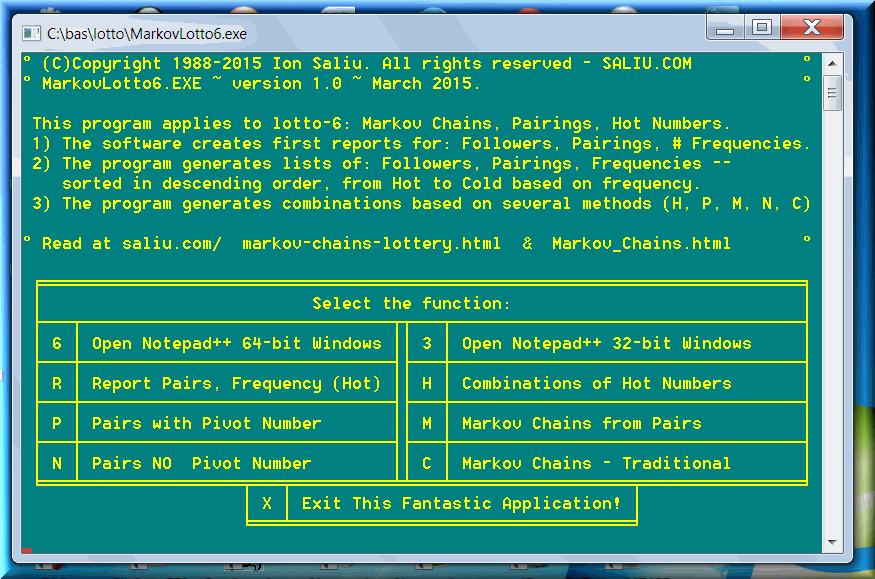
And here is, axiomaticus, a most effective function in lottery of an application of a Markov-Chains algorithm — M = Generate Combinations from Pairings as Markov Chains:
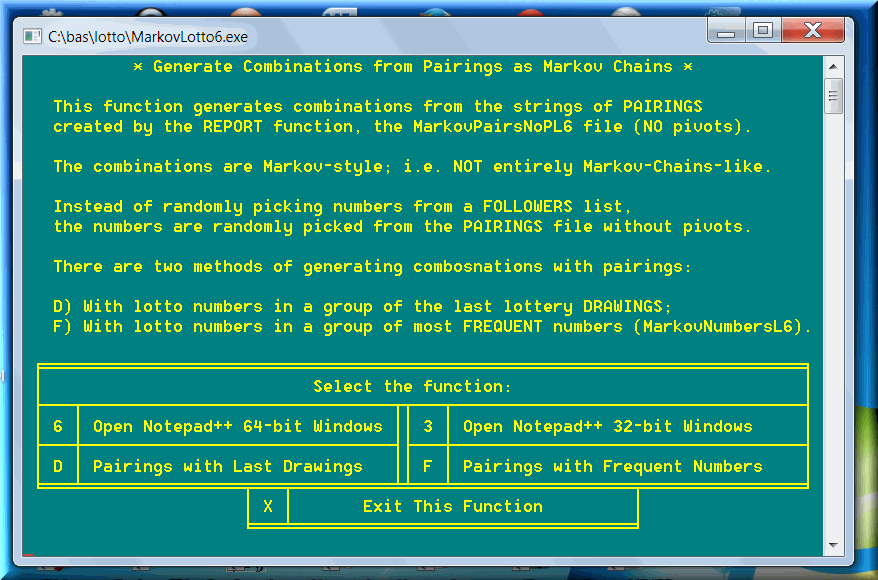
— and this is a most effective method of a lotto Markov-Chains algorithm — F = Pairings & Most Frequent Numbers:
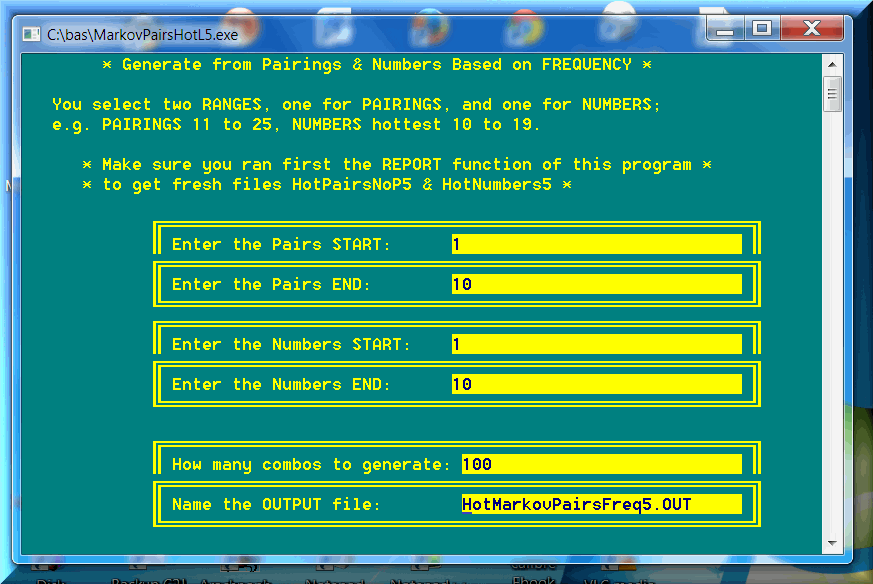
By the way —
CoolRevGui was written for Windows NT, an older platform. It works great with files under 32K. It may work fine with files over 32K, depending on the OS and its components. In my case, and other cases, it does not work properly with very large text files.
The GUI versions change their objects and components (e.g. dialog boxes) quite often — thusly creating incompatibility. On the other hand, my 32-bit command prompt lottery software has worked flawlessly with all 32-bit and 64-bit versions of Windows, from Windows 95 to Win 10. Way to go, axiomatic one! You deserve a perfect 10, Parpaluck, as in Windows 10, 2015 and thereafter!