
The Best or Better Odds, Probability to Win: Lottery, Lotto — or Casino Gambling?
By Ion Saliu,
Founder of Gambling Mathematics, Founder of Lottery Mathematics

Posted on April 14, 2000; later updates.
This article is in response to a message on the old guestbook (no longer available ... O tempora, O mores!) From a winning perspective: What's best, or, at least, better? Playing the lottery or gambling in a casino? From a probability theory perspective, considering the odds, the casinos offer far better odds than the lotteries. Moreover, the house advantage or house edge (or player's disadvantage) is much more...favorable to the gambler in a casino.
On the other hand, casino gambling is far more dangerous because it is fast-paced. Casino gambling also gives the tempting impression, the get-drunk-with-illusions feeling that it is the path to riches. The winning odds are good, the house edge is good, right? It can be, but only for the best trained professional gamblers. There are few and far between real professional gamblers. The main reason is lack of mathematical knowledge. Also, lack of a mathematically solid bankroll, if you ask me...
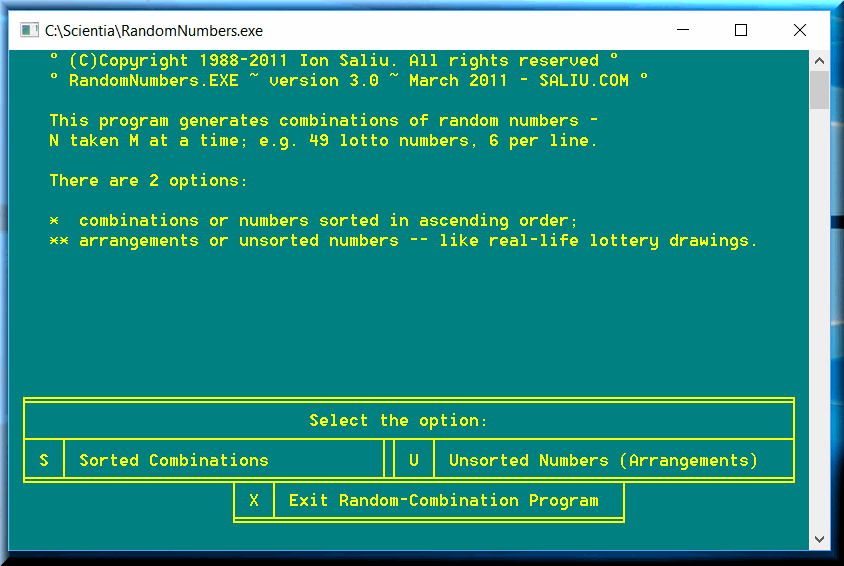
I have written probably the best random number generators. I even offer the source code of the basic program: RandomNumbers. The software source code can be easily adapted to serve many other purposes. Following is a screenshot of the compiled program.
You can run also the generators in other software packages you'll find here: the Util* programs (more powerful Super Utilities in the Bright software packages). Select the option Simulate to generate lottery or horse racing combinations.
Run the random generators several times before playing. The mathematical truth is that it takes some time to get the winning combinations. You only run the lottery software, but do not pay anything, because you don't play! You accomplish a sort of time compression. You can save lots of money.
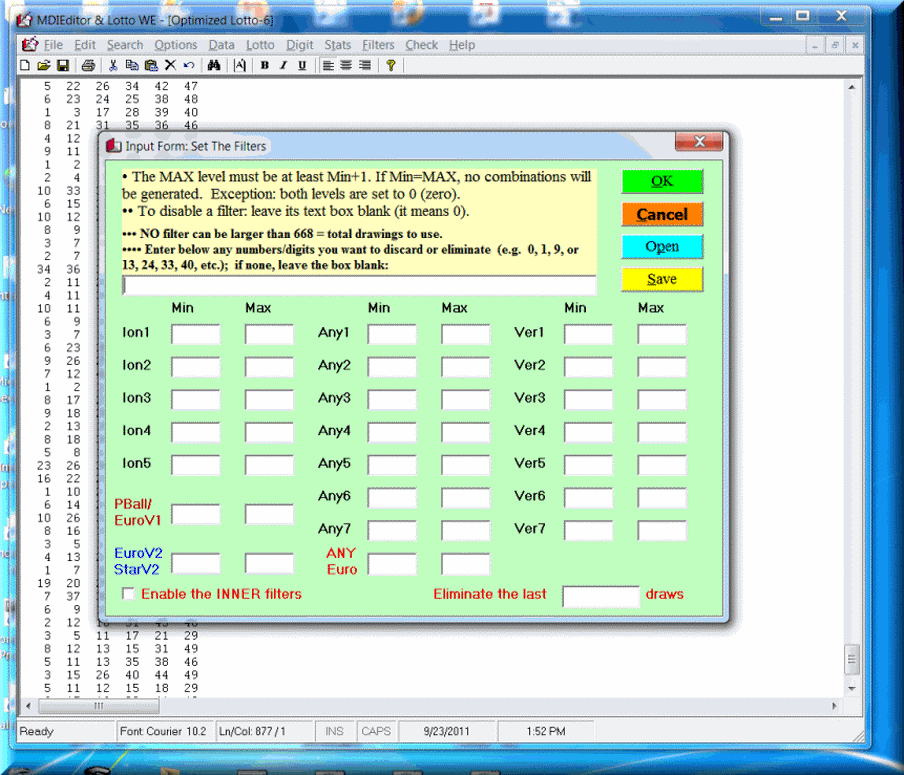
The most comprehensive lotto, lottery, gambling software of all time can do all of the above, plus a whole lot more. The software is known as MDIEditor Lotto WE. For starters, the program can generate random but optimized lotto, lottery combinations. It can accomplish much, much more if you are willing to invest extra effort and time.
Casual lotto, lottery player you can follow these links in confidence:
Resources in Lottery, Software, Systems, Lotto Wheels, Strategies
It lists the main pages and links to the best lottery, lotto, software, systems, and wheels. It's all about winning lotto, lottery systems, including for pick lotteries, Powerball, Mega Millions, Euromillions and Keno.
There are caveats, however! Casino gambling is a very fast-paced action. You may be seduced by a quick small win. You go bigger and soon lose all your money! It's especially true as far as the slot machines are concerned. The atmosphere in casinos is designed to bamboozle the player, to make you feel tipsy. Casinos also employ subtle deception. The real odds are not always presented, but false surrogates, such as in the case of slot machines. The lotteries are under more strict control; therefore fraud has a significantly lower probability. By contrast, cheating by casinos is a real possibility. Also, this author strongly believes that the chips inside the casino slot machines are rigged. Read more: Fearing Losses, Casinos Bar, Ban Winning Gamblers, Skilled Gambling Players.
The amateur casino gambler must seriously consider the mathematical presentation you find on these pages:
It is the best mathematical casino gambling strategy (playing method) for non-system players. The probability is real that the gambler can be ahead at some points during a gambling session. The player must have the strength to put an end to a winning streak. Leave that game and go to another one. You'd better read carefully the two pages. It can save you a truck of money.
Resources in Theory of Probability, Mathematics, Statistics, Combinatorics
Lists the main pages and links to the best in theory of probability, combinatorics, statistics, mathematics. The very original formulas and theories are always backed by specific computer programs. The computers are so much faster and more accurate than the humans!
Resources in Blackjack, Baccarat: Theory, Mathematics, Basic Strategy
Lists the main pages and links to the best blackjack, baccarat, software, systems, and strategies. It's all about winning blackjack, baccarat systems, including the famed Basic Strategy.
Resources in Roulette: Theory, Mathematics, Super Strategy
Lists the main pages and links to the best roulette, software, systems, and strategies. It's all about winning roulette systems, including the famed Super Roulette Strategy.
Resources in Sports Betting: Theory, Mathematics, Excel Spreadsheet
Lists the main pages and links to the best sports betting, software, systems, and strategies. It's all about winning sports betting systems, including the generating of parlays.
If you play 1 roulette number for the next 38 spins, common belief was that you expected to win once. NOT! Only if you play ALL 38 roulette numbers in ONE spin, your chance to hit the winning number is 100%. There is an interesting table, which includes also The Free Roulette System #1 presented at the main roulette site.
If I play 1 pick-3 straight combination for 1000 lottery drawings, my chance (degree of certainty) to hit the winning combination is approximately 0.632 (63.2%). On the other hand, if I play all 1000 pick-3 straight sets in one draw, the chance is 100% that I'll hit the winning lottery number. Of course, I still lose money because of the (monstrous) house edge. Things look very different now. The gain is 100 – 63 = 37% when playing all 1000 pick-3 lottery combinations in one drawing as opposed to playing one combination in 1000 lottery drawings.
Let's say one persistent pick-3 lottery player plays 10 tickets (straight combinations) each and every day of the year. The individual probability is now p = 10/1000 = 1/100. The total cost amounts to 3650. What is the probability to hit at least one winning combination in one year (365 trials)? You can run my probability software SuperFormula, option L = At Least M Successes in N Trials. The degree of certainty is 97.4%. It's not 100% yet! It's for real that none of 10 lottery numbers you select hits on a particular day. But let's consider the degree of certainty 100% — therefore one success. Meanwhile, if I play 1000 tickets a draw in 3 pick-3 lottery drawings, I'll be assured of 3 successes.
There is a clear advantage of playing selectively more in few. There is a mathematical advantage of playing lotto, lottery strategies as outlined at this web site. There is an indisputable advantage in skipping draws and saving the money for playing selectively relatively few lotto drawings.
This is the worst type of gambling: Spread one's bankroll over relatively long sessions. Casino gambling, in general, doesn't allow playing selectively. If you are at the table, you must play every roulette spin, the player is warned. But the player is allowed to increase the bet — the smart gamblers do so at rare but optimal moments.
The worst of the worst is to piecemeal one's bankroll. Like blackjack players I've seen opening their wallets with over $1000 and chipping in for just $100. Then $100, and again, and again… They would have had a far better chance if chipping in at $500 – $1000 right from start!
The lotto systems that can be applied with my software follow Ion Saliu's Paradox of N Trials. The player waits for special moments when a lotto strategy has a higher probability to come to life. The player does not play every lottery drawing. Money is saved; the increased bankroll is spent more efficiently on occasions that prove to have a mathematical advantage.
Here is an illustrative table of Ion Saliu Paradox. It is founded on undeniable mathematics that even school children should comprehend, especially senior citizens addicted to casino slots!
| Type of Play | Winning Chance % | Cost in Units | Gain for Saliu's Paradox % |
| Play 1 # in 38 Spins | 63.7% | 38 | - |
| Play 38 #s in 1 Spin | 100% | 38 | 1 - .637 = 36.3% |
| Play 34 #s in 1 Spin | 89.5% | 34 | 28.8% |
The maximum gain comes when playing 38 numbers in one spin: 36.3%. Obviously, it makes no sense to play that way because of the house advantage. On the other hand, a so-called wise gambler is more than happy to play one number at a time. What he does is simply losing slowly! Not only that, but losing slowly is accompanied by losing more. That cautious type of gambling is like a placebo. A roulette system such as The Free Roulette System #1 scares most roulette gamblers. “Play 34 or 33 numbers in one shot? I'll have a heart attack!” In reality, the The Free Roulette System #1 offers a 28.8% advantage over playing singular numbers in long sessions. That's mathematics, and there is no heart to worry about.
Read this: Casino Strategy, Roulette Systems Based on Roulette Marquee Numbers
So far, I have not seen one single roulette marquee showing a string of 15 unique roulette numbers in 15 consecutive spins. The roulette numbers do repeat — quite often in some streaks. Observe the streaks, gambler! It is elementary — Theory of Probability is the Science of Streaks (run Streaks, the probability software).
Of interest: