
Software to Calculate Binomial Distribution Formula, Probability of Multiple Successes in a Number of Trials
By Ion Saliu,
Founder of Probability Theory of Life

Published on January 27, 2001. O tempora! O mores!
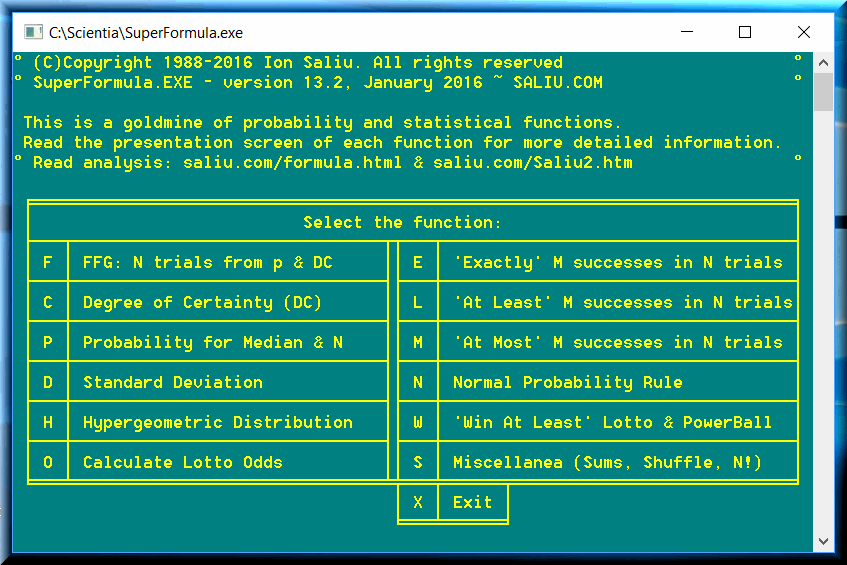
FORMULA has been upgraded to calculate also the Binomial Distribution Formula (BDF). This formula calculates the probability of exactly M successes in N trials, when the probability p is constant. It deals with a sequence of events, such as a number of coin tosses. It proves that what happened in the past is relevant to the next trial. For example, we want to determine the probability of getting exactly 5 heads in 10 tosses. We tossed the coin 7 times and recorded 5 heads. We toss the coin for the 8th time and get another heads (the 6th). We must stop the tossing; the experiment failed. We can no longer get exactly 5 heads in 10 tosses. It is obvious that the previous events influenced the coin toss number 9.
Sequence of events means that the events do not take place at the same time: They occur serially, one after another.
The Binomial Distribution Formula shows some interesting facts. For example, the probability to toss EXACTLY 1 tails in 10 tosses is only 0.98%. It is quite difficult to get only 1 tails and 9 heads in 10 tosses.
The probability to toss EXACTLY 5 heads in 10 tosses is 24.6%. It is not that usual to get exactly 5 heads in 10 trials, even if the individual chance is 50%! We might have thought that we would get quite often 5 heads and 5 tails in 10 coin tosses. After all, it is a 50-50 proposition. NOT! The chance is even slimmer to get 500 heads and 500 tails in 1000 tosses: 2.52%.
The probability to get 5 heads in 5 tosses represents, actually, the probability of 5 heads in a row (3.125%).
We can work with complicated case scenarios as well. Let's take, as an example, roulette. (Methinks you're here mainly because of a strong interest in gambling mathematics.)
The software has a data size limit. The number of trials N must not be larger than 1500. N! (N factorial) for numbers larger than 1500 leads to impossible-to-handle amounts for today's PCs. There will be an overflow if you use very large numbers...
Axiomatic one, here is the generalized formula for exactly M successes in N trials:
BDF = probability, chance of exactly M successes in N trials;
p = the individual probability of the phenomenon (e.g. p = 0.5 to get heads in coin tossing);
M = the exact number of successes (e.g. exactly 5 tails in 10 coin tosses);
N = the number of trials (e.g. exactly 5 tails in 10 trials).
Resources in Theory of Probability, Mathematics, Statistics, Standard Deviation, Software
See a comprehensive directory of the pages and materials on the subject of theory of probability, mathematics, statistics, standard deviation, plus software.
Comments:
Home | Search | New Writings | Software | Odds, Generator | Contents | Forums | Sitemap