

Most of the gambling roulette systems I saw pile up to nothing more than junk. Very few strategies have some value by just touching mathematics. Surprise, surprise — I saw also Powerplay Roulette on the list! Remember the gambler named Chip who caused some disruption at this Web site? "Chip Casher" said that Power Play Roulette System sold for some $5,000 (five thousand US dollars!)
No exaggeration! Let them take me to court, if they wish or dare — I'd make the same statements and produce compelling evidence! Better still, I suggest you take my statements to the bank! By the way, I licensed my Super Roulette Strategy for only $100 back in the year of grace 2000! No wonder (some of) the gambling suckers I sold my super systems to reacted cutthroat-like against me. They wanted me to STOP licensing my roulette systems!
Here is a long list of roulette systems saved for future reference. I can't believe how much fraud there is! I am suspicious and say it again: Only the casinos would be so fiercely aggressive and sell roulette and gambling strategies priced from US $5000 (five thousand) to US $40000 (forty thousand)! No individual gambling system developer would be thus fearless and dare to sell such outrageously priced casino gambling systems! It could turn deadly for him! Read this page:
A) The probability p for a single zero roulette game is: p = 1/37 = 0.027.
We apply the Fundamental Formula of Gambling to one value of DC (degree of certainty): 66.6% (or 2/3, 2 out of 3 cases). For DC = 66.6%: N = 40.4 (rounded up to 41 spins). There is a 66.6% (2 in 3) chance that each roulette number will repeat after 41 spins. Equivalently, there is a 66.6% chance that the next spin will be a number that also appeared within the last 41 spins.
B) The probability p for a double zero roulette game is: p = 1/38 = 0.026.
We apply the Fundamental Formula of Gambling to one value of DC (degree of certainty): 66.6% (or 2/3). For DC = 66.6%: N = 41.5 (rounded up to 42 spins or 41 for single-zero wheels). There is a 66.6% (2 in 3) chance that each roulette number will repeat after 42 spins. Equivalently, there is a 66.6% chance that the next spin will be a number that also appeared within the last 42 spins.
The accompanying roulette program SuperRoulette simulates spins for the double-zero roulette game in order to cover the worst-case scenario. We'll use now only the final part of the report. After a very large number of spin simulations, the 42-spin value confirmed FFG. Also importantly, even smaller number of roulette spins confirm FFG for a DC = 66.6%. Let's use the Fundamental Formula of Gambling with confidence. That's what formulas are for.
We'll use this number (42) in correlation with limited-steps Martingales (bets based on a Martingale progression). Basically, Martingale represents a gambling betting method. It doubles up the previous bet until the last step of the betting. For example, a 4-step Martingale using a one-unit bet follows this path: 1 unit; 2 units; 4 units; 8 units (step 4, end of betting). Don't worry about using a Martingale: the Formula makes Martingale a closed betting gambling system (a system with a limited number of steps).
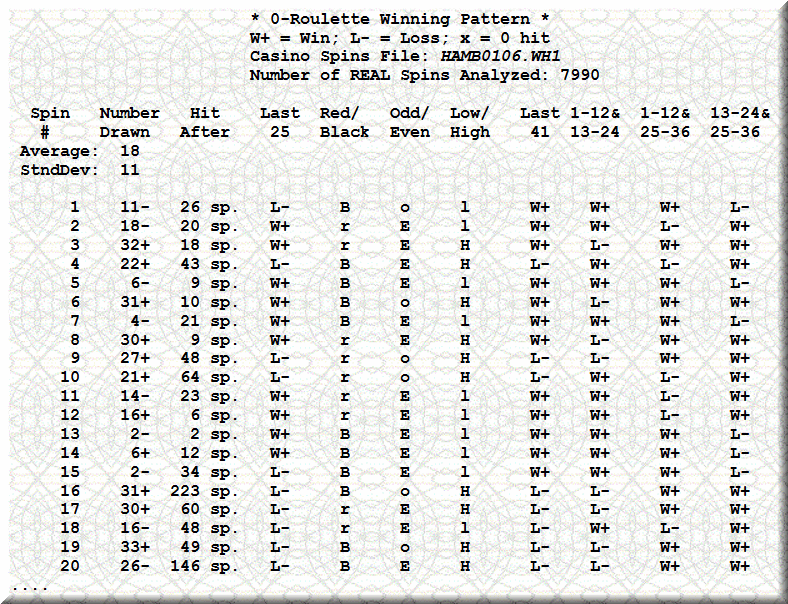
The win/loss WL streaks report was generated by the gambling software Super Roulette, available to all registered members of this Web site.
The column Last 26 Roulette Spins reflects a DC (Degree of Certainty — see FFG, Fundamental Formula of Gambling) of 50% (it is 25 for single-zero casino roulette wheels). In half the situations, the next roulette number would have also appeared in the previous 26 spins. I decided not to use a betting system based on a DC = 50%. The losing streak can reach sometimes 10-13 spins in a row. Also, the losing/winning streaks are far more irregular. Instead, I chose to base my gambling betting systems on DC = 66% since the winning/losing streaks are a whole lot more manageable.
SYSTEM 1: Applies to Report Column Last 42 Roulette Spins.
The degree of certainty is 66.6% that the next spin will be a number that also appeared within the last 42 spins. In most cases, there are 25-26 numbers to play, since some numbers are repeats. The advantage of this system: the losing streaks (L or -) are far shorter, more regular, and less frequent.
From the opposite viewpoint, the winning streaks (W or +) are far longer, more regular, and more frequent. We can play a more efficient and safer Martingale.
First, we need to keep a good record of the spins. We (you, if you will) need to make the record accurate and easy to read. AFTER the spin # 42, write down + or W if the number was a repeat from the last 42 spins; or - or L if the roulette number was not a repeat from the last 42 spins. Also, keep writing the numbers drawn. You'll write two rows such as:
16,11,16,15,20,36,28,32,19,28,13,24,2,16,23,31,10,19,27,8,26,27, 00,19,16,12,36,18,9,8,30,6,14,17,25,12,8,3,17,18,10,13,| 7,14,2,19,7,24,32,2,25,11,13,29,17,25,25,14,26......... (1st
row!)
-- keep a few empty lines for more spins ---
-++++++++-+-+++++ (2nd row)
The bar | after #13 marks the start of the betting for System 2. The first number drawn after you marked the start of the betting is 7. It does not appear among the previous 42 spins, so you write a - in the streak column. I prefer +/- rather than W/L because I can visualize easier the winning/losing streaks. The next operation is to write another bar after 16. It will make it easier to figure out the current 42-number roulette block. In this example, it will be between 11 (the number following 16) and 7.
The next number drawn was 14, which appeared also in the previous 42 spins. Write a + in the streak column. Write another bar after 11. The new 42-number block will span between 11 and the 14 just drawn.
So, you always write down the very last number drawn and move the marking bar one number to the right. This way, you don't have to count the previous 42 spins. Place your chips on the numbers between the two bars marking the latest 42-number block. Of course, some numbers are repeats, so you only need to play each number once. In most cases, you'll only play 26 unique roulette numbers (sometimes 24, sometimes 27).
In most cases, we'll win right away. If not, we wait for the next LL or longer streak. We'll use a power-3 Martingale: 1-3-9-27 etc. When the LL streak ends, we'll bet 3 units on all the numbers drawn in the last 42 spins. It may be even less frequent to encounter another LL or longer streak. If it occurs, we may regret if we didn't continue the Martingale with a 9-unit bet!
S1.2: Applies to Report Column: Last 42.
In reverse, we can bet on W groups longer or equal to two (WW, WWW, WWWW, etc.) Now, we wait for two consecutive groups of single W.
At the next W (after an L) we bet that it'll be another W. In most cases, we'll win right away. If not, we'll bet 3 units at another W after an L.
* The safer variations on the last two roulette betting methods. We can wait for three single W groups and bet directly $10 or $20 at the very next W after an L. There is no such an occurrence in the report above. It might occur, albeit rarely. We can wait for three LL groups (2L or longer) and bet directly $10 or $20 at the very next L after a W. There is no such an occurrence in the report above.
What would the cost amount to? $10 x 26 numbers = $260.
The winning: $36 x 10 = $360.
Profit: $100.
Based on the Fundamental Formula of Gambling, these are the streaks for a probability p=0.666. The degree of certainty DC is 95% that the losing streaks will be no longer than 3 (LLL). The degree of certainty DC is 99% that the losing streak will not be longer than 4 consecutive losses (LLLL).
The chance of coming across 3 consecutive LLL groups is :
5% (0.05) to the power of 3 = 0.000125 (1.25 in 1000).
The chance of coming across 3 consecutive LLLL groups is :
1% (0.01) to the power of 3 = 0.000001 (0.001 in 1000).
The 66.6% probability offers a tremendous advantage over probabilities around 50%. First and foremost, the losing streaks are definitely shorter. There is a 99.9% degree of certainty that the losing streak will be no longer than 6 when p=66.6%. That can make possible to use an intelligent Martingale after a second or (more safely) third loss in a row (LL or LLL). In 999 out of 1000 roulette spins, the L streak will go no longer than 6. Therefore, a Martingale will go no longer than 4 or 5 steps. That is perfectly manageable within the minimum/maximum ratios at the roulette tables.
Secondly, the winning (W) streaks are definitely longer than the losing (L) streaks. It is very rare that two groups of single W will not be followed by W streaks longer than two (WW, WWW etc.). We can reverse the Martingale technique presented above. After the second single W (such as LWLLWL) we'll start another 4 or 5-step Martingale.
We should also expect (high expectation, indeed) that W streaks of 4 or longer are common. Therefore, if we do not see such W streaks in the last 3-4 W streaks, we should bet they will occur soon. If there is a W/L string such as WWLWLLWLWWLLW I can bet there will be another W, and another one.
* The disadvantage of the roulette systems based on p=2/3: the use of a power-3 Martingale: 1-3-9-27-81.
The Roulette Systems based on p=1/2 applies a power-2 Martingale: 1-2-4-8-16...
   SYSTEMS 2, 3, 4: Apply to Report Columns:
  1-12&13-24  1-12&25-36    13-24&25-36
      A           B              C
These roulette systems are a variation of SYSTEM 1, based on the 66.6% degree of certainty. At the same time, they are a reply to the fictitious roulette "system" presented in the James Bond novels and films. No doubt, the author of the James Bond novels, Ian Fleming is a person with a strong interest in roulette. He noticed what I presented above: the winning streaks tend to be longer than one (WW or longer) for degrees of certainty above 50%.
Fleming, however, has no clue on the mathematical foundations of such occurrences. James Bond plays 1-12 AND 13-24, betting large amounts of money. Since it is fiction, James Bond always wins at the roulette table! Now, if any person in this world will walk to a roulette table and place bets on 1-12 AND 13-24, he/she will win a 2-to-1 payoff 65% of the times at French roulette (64% playing American roulette).
In other words, if you would play this way at any roulette table three times in a row, you will win a 2-to-1 payoff two times (not necessarily twice in a row). You will also lose once, roughly. That's a far cry from the 100% winning insinuated by Fleming in his book Casino Royale.
You should never, ever play in that manner at the roulette table! You should enter the game at favorable moments, as presented in SYSTEM 1. When such favorable moments occur, get ready to use a limited-step Martingale (no longer than 4 or 5 steps). The betting sequences are 1-3-9-27 etc. This is determined by the 2-to-1 payoff when playing 12 roulette number groups (douzaine in French).
When using this betting plan, you are only allowed to place bets on numbers 1 to 36. You are not allowed to include 0 (or 0 and 00) in the groups of numbers you bet on. The 36 numbers can be divided into three groups: A (1-12 and 13-24); B (1-12 and 25-36); C (13-24 and 25-36). Each of the three groups (A, B, or C) has an equal probability: p = 64% (in the American roulette) or p = 65% (in the French roulette). The two probabilities are very close to the degrees of certainty we used as the foundation of SYSTEM 1 (66.6%). Consequently, we will encounter virtually the same composition of the W and L streaks.
SYSTEMS 1.3, 1.4, 1.5 do not require a long tracking session at the roulette table. The table will show the last 20 spins, so you can start betting immediately. You can choose to play only one of the three double-douzaine groups: A, B, or C. Or, you can play two of the groups, or all three groups. It is best, however, to keep track of all three groups. Only one of the three double-douzaine groups will have a stronger advantage over shorter tracking sessions.
   It is easy to memorize what the groups represent:
   A = 1st douzaine + 2nd douzaine (1-12 & 13-24);
   B = 1st douzaine + 3rd douzaine (1-12 & 25-36);
   C = 2nd douzaine + 3rd douzaine (13-24 & 25-36).

   You will write the roulette numbers drawn in the first row
   and the W+/L- streaks in the next 3 rows:
       11 21  7 32 25 2  2 29 23 7 29 28  7 34 27
    A: +  +   + -  -  +  + -  +  +  -  -  +  -  -
    B: +  -   + +  +  +  + +  -  +  +  +  +  +  +
    C: -  +   - +  +  -  - +  +  -  +  +  -  +  +
We apply the same betting principles presented in SYSTEM 1. The structures of the W+/L- streaks are very close to the W+/L- strings encountered in SYSTEM 1. Keep in mind this mathematical rule. When the probability p is significantly above 50% (10%+ above 1/2), most of the winning streaks (W+) are two in length or longer (WW, WWW, WWWW, etc). On the other hand, most of the losing streaks (L-) are singles (LWWLWLWWWLLWLW...). When betting, we know that only rarely will we encounter:
* More than three consecutive groups of LL or longer (LLL, LLLL ...). Using the +/- notation and a real report generated by SuperRoulette, a W/L streak looks like this: ++-+++--+--+++--++-+
You can see three consecutive groups of LL (--). The very next L group was single (-), ending the L streak longer than or equal to 2.
* More than three consecutive groups of single W+. Using the +/- notation and a real report generated by Super-Roulette special program, a W/L streak looks like this: --+++++----+-+---+++
You can see two consecutive groups of single W+. The very next W group was longer than 2, ending the single W+ streak.
Based on the two probability facts, we can devise two betting methods. They are similar to the methods described in SYSTEM 1.
S234.1: We check to see which of the groups A, B, C has two or more consecutive groups of LL or longer. At the end of two consecutive groups of LLW or longer (LLLW, LLLLW, etc.) we place one unit bet on a douzaine and another unit bet on the other douzaine of the A, or B, or C group. Let's look at a practical example. Group A has had the following streak: ++-+++--+--+++--++-+, or using the W/L notation: WWLWWWLLWLLWWWLLWWLW
You can notice three consecutive LLW groups. The second group is LLWWW; then an L (or -) follows. You start betting right there, after the first L. You know that there is a high probability to get a single L. In this example (a real case, though), you lost your roulette bet. The first L was followed by another one.
The L streak ended with WW. Another L follows. You start betting again after that first L. The probability is even higher now for L to be single (that is, it will be followed by W). Bet now 3 units on the first roulette douzaine of the group and 3 units on the other douzaine of the group. In this case, you won a 2-to-1 bet. You won 3 x 3 units = 9 units. Your cost was 3 units + 3 units = 6 units. The net gain is 3 units. But you lost the previous bet: 1 unit + 1 unit = 2 units. Deducting 2 units from the gain above, your final gain is 1 unit.
S234.2: We check to see which of the groups A, B, C has two or more consecutive streaks of single W.
At the end of two consecutive groups of WL we place one unit bet on a dozen and another unit bet on the other dozen of the A, or B, or C group.
Let's look at a practical example. Group A has had the following streak: --+++++----+-+---+++, or using the W/L notation: LLWWWWWLLLLWLWLLLWWW. You can notice two consecutive LWL groups (isolated W or +). The second group is LWLLL. Then a W (or +) follows. You start betting right there, after the first W. You know that there is a high probability to get a W longer than one (WW, WWW, etc.). In this example, you bet $10 + $10 (after that 1st W) that another W will follow. It actually did happen, so your payoff was $30 ($10 profit).
If it did not happen (as in case S234.1 above), you would continue with a double-up base-3 bet: $30 + $30 = $60. In by-far-most cases, you will win a $90 payoff. The profit would be:
$90 - $60 - $20 = $10.
Do not fear reality. If you lost again, you would continue with a double-up base-3 bet:
$90 + $90 = $180. In the most cases, you will win a $270 roulette payoff. The profit would be:
$270 - $180 - $60 - $20 = $10.
You can still lose another step and double-up within the roulette table maximum bet. Losing that many steps in this manner is so extremely rare, that it may take to play the roulette for many, many thousands of spins in a row.
* The safer variations on the last two betting methods.
We can wait for three single W groups and bet directly $10 or $20 at the very next W after an L.
We can wait for three LL groups (2L or longer) and bet directly $10 or $20 at the very next L after a W.
I was reluctant to recommend roulette systems based on p=1/2. People may be tempted to use Martingales that a losing streak will end within 4 or 5 steps. Please do not do that: A losing streak can reach 13-15 spins at times, albeit rarely! Instead, I will show you a more intelligent type of betting. They are similar to the systems in category 1. They also use a power-2 Martingale: 1-2-4-8 since the payoff is 1-to-1.
   The report columns for this betting category are:
           Last  Red/   Odd/  Low/
            26   Black  Even  High
S2.1: It is very rare that there are more than three consecutive groups of LL or longer than 2L.
Therefore, at the end of the 3rd LL or longer streak we'll bet 1 unit on all the roulette numbers drawn in the last 26 spins (17-20 numbers to cover, 18 in most cases). In most cases, we'll win right away. If not, we wait for the next LL or longer streak. We'll use a power-2 Martingale: 1-2-4-8 etc. When the LL streak ends, we'll bet 2 units on all the roulette numbers drawn in the last 26 spins. It may be even less frequent to encounter another LL or longer streak. If it occurs, we may regret if we didn't continue the Martingale with a 4-unit bet!
S2.2) In reverse, we can bet on W groups longer or equal to two (WW, WWW, WWWW, etc.) Now, we wait for three consecutive groups of single W. At the next W (after an L) we bet 2 that it'll be another W. In most cases, we'll win right away. If not, we'll bet 4 units at another W after an L.
* The safer variations on the last two betting methods. We can wait for four single W groups and bet directly 4 units at the very next Win after a Loss. We can wait for four LL groups (2L or longer) and bet directly 4 units at the very next L after a W.
SYSTEMS 2.3, 2.4, 2.5 cover the even-money bets: Red/Black, Odd/Even, High/Low. They follow the same rules as S2.1 and S2.2. In this case, however, we do not track W/L, but B/r, o/E, H/l.
* Let's take the Black/Red bet. Write first the numbers drawn:
36 10 29 25 16 1 22 4 7 23 26 4 10 29 21 27 16 15 6 37 19 22 29 36 18 16 30 37 35 10 37 15 16.
Next, write down what the roulette number represents: B for black, r for red and x for 0/00:
rBBrrrBBrrBBBBrrrBBxrBBrrrrxBBxBr.
Bet 2 units after the 1st B in the 4th B group 2 or longer (it is BB after the 3rd r in the row above). We lost, because the BB streak did not end there. The next B (black at roulette) group of 2 Bs or longer meant we lost again; this time we lost 4 units. Another BB group follows and we bet 8 after the 1st B in the group; there is an x, then another B. We win this time. A safer variation is to wait for four consecutive BB or longer groups. They occur far more rarely, however.
We can do the same thing betting on r. You can notice there are 3 rr or longer groups (rrr, rr, rrr). They are followed by a single r (...BxrB...)
* As in System S1.2, we bet on the continuation of singles (single B, single r, etc.). Let's look at this Odd/Even streak:
oooEoExoEoEEEExoExoEoEEoEooE.
We bet 2 units after the 3rd single o. We lose. More single o groups followed and we used the following Martingale: 4 (loss) - 16 (loss) - 32 (loss) - 64 (WIN). 64 times $5 = $320, an acceptable maximum limit at most roulette tables. The roulette game in Garmisch-Partenkirchen, Germany has a maximum limit of DM 6000 for even-money bets (for a DM 5 minimum limit).
Some roulette numbers hit more frequently than others within certain ranges of spins. Percentage-wise, the frequency differences are not mathematically significant. And nobody can accurately predict which number will be more frequent within the next range. The operative word here is SKIP. The SKIP represents the number of roulette spins a number waits between hits. The skip varies between 0 (zero, i.e. consecutive hits; it is also 1: number of spins back) to over 200.
These roulette skip values are absolutely in accordance with the Fundamental Formula of Gambling. It will be common occurrence that your favorite roulette number will skip over 100 spins at any given time (during your playing session). So, what's the big deal of winning $36 after you lost $100? How about waiting 200 roulette spins for your number to hit? It really happens! Also, it is very unwise to track 100, or 200 spins, given the $35 potential win!
Conclusion: I do not recommend you play a favorite roulette number.
SA2: Bet That the Next Roulette Number Will Be a Consecutive Hit It certainly happens around 26 times in 1000 spins. Playing this way, we still lose 5.26% of our total bets. As you can notice in the SuperRoulette reports, sometimes it happens 35 times (or more!) to encounter consecutive hits in 1000 roulette spins! Indeed, there are these situations: You play on consecutive hits and win 30 times (or more) within 1000 roulette spins. You are a winner! But that doesn't happen all the time, first of all. Secondly, the profit is not that big. Keep in mind also that you can wait for a consecutive hit over 150 spins sometimes...
Conclusion: It's not worth the risk! You should use it only when you must play in order to keep your seat at the roulette table! You can improve the outcome somehow by skipping some spins.
SA3: Instead of betting on consecutive hits, you bet that the next number would have also hit in the last 0 to 9 roulette spins. It is a combination of the two NON-betting methods presented above. In this case, the situation is more manageable, because the probability p is higher: p = 1/4 (approximately). You remember the rules above. If the probability p is significantly above 50%, there are more frequent winning streaks and shorter losing streaks. Conversely, if the probability p is significantly below 50%, the losing streaks are longer. In the case of p = 1/4, the losing streaks can reach over 30 roulette spins! It's dangerous to bet with the expectation that the next roulette number would have also hit in the last 0 (1) to 9 (10) spins.
Tracking is easier than in the case above, but still difficult. There is a new element we can use in these situations, however: the median. Look at the SuperRoulette roulette software reports (the ROULETTE.REP file). The median for 1 to 10 hits is 2 or 3. In half or a little more than half the cases, the median will be 2. In other words, the next roulette number will be a repeat from the previous 10 spins in a little more than half the cases when this betting hits.
More explicitly: This type of betting hits around 250 in 1000 spins (1 in 4). In a little more than 125 roulette spins, the betting will hit within 3 spins from one another! If you think it is complicated, it probably is. Don't continue to read it, IF you don't understand it! Keeping track of this type of betting is complicated, too. So complicated, that I do not recommend you use this type of roulette betting! Nobody knows better than me how the Fundamental Formula of Gambling works (the configuration of W/L streaks). You should use it only when you must play in order to keep your seat at the casino table! Especially use it when it hit within the last 3 spins.
Look at the main screen of SuperRoulette (also Roulette) casino gambling software.
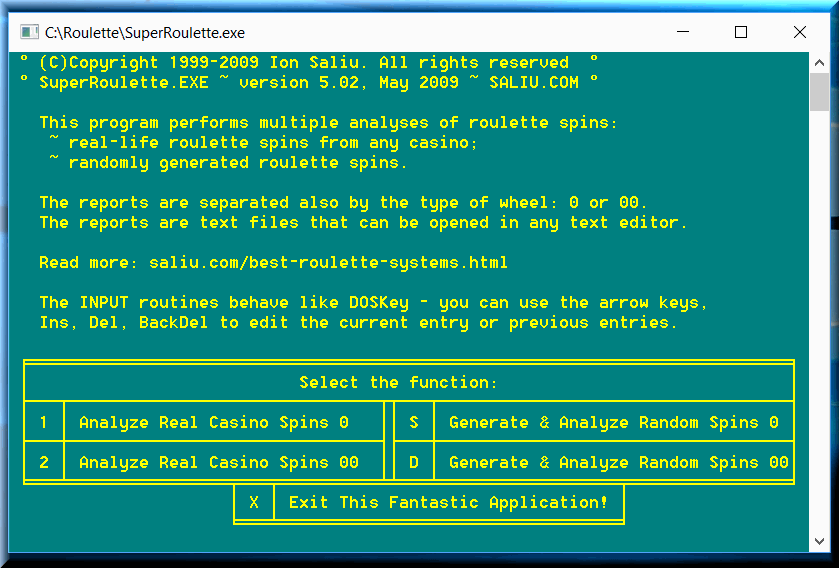
You can also download here two files with actual roulette spins recorded at the Hamburg, Germany casino. The file HAMB00.DAT covers the period February 1-6, 2000. The other file, HAMB0106.WH1, covers the entire month of January 2006 (7990 real-life roulette spins… I can only assume real or correct or accurate… it's impossible to verify such data!) The data files are ASCII or simple text files. They look very much like the random output files generated by Super Roulette in random mode (Random0.DAT or Random00.DAT). The files contain roulette numbers (spins) only, one number per line. The casino actuals have also other data, such as frequency and various statistics. The files also have dashed lines (----) which probably represent casino dealer changes.
HAMB0106.WH1 that I edited and saved represents the best recording format: Table by table. Do not mix the spins from different roulette wheels in the same file. Also, the most recent roulette spin always goes to the top of the file, while the oldest spin (casino result) goes to the bottom (bottom line). Each file line contains one roulette spin and ends with a carriage return (pressing Enter). Make sure you do not leave any blank lines: They are treated as roulette number 0 (zero). If your file is for double-zero roulette tables, be sure to type 37 instead of 00.
By the way, those files can be precious items! Most casinos do not want to offer real roulette spins. Hamburg Spielbank sometimes offers results (actual spins), sometimes doesn't. Another German casino does the same thing: Spielbank Wiesbaden. You can try casino links like these two (not in directly-clickable format, because they change addresses way too frequently):
spielbank-hamburg.de/spielsaal/permanenzen.php4)
spielbank-wiesbaden.de/DE/621/Permanenzen2.php
Read Ion Saliu's first book in print: Probability Theory, Live!
~ Founded on valuable mathematical discoveries with a wide range of scientific applications, including probability theory applied to roulette gambling, software, Roulette Strategies.
Roulette: Software, Content, Resources, Systems, Super Roulette Strategy
See a comprehensive directory of the pages and materials on the subject of roulette, software, systems, and the Super Strategy.
Home | Search | New Writings | Odds, Generator | Contents | Forums | Sitemap