
Lotto, Lottery Software to Calculate Sums, Sum-Totals, Odd-Even, Low-High Patterns
By Ion Saliu, Founder of Lottery Mathematics

Written on February 02, 2002; later updates due to advancements in computing.
• I received a strange request from a... school student! The teacher (?) gave the class a programming assignment:
The question was exemplified for a particular lotto game (Florida... say, Kokostirk?) Let's say, a 6/49 game. The sum-totals of the combinations range between 1 + 2 + 3 + 4 + 5 + 6 = 21 and 44 + 45 + 46 + 47 + 48 + 49 = 279. How many lotto combinations are there for the sum-total 150? How many for combinations adding up to sum 49?
Child or parent, there is a tendency to look for so-called patterns in lotto games. One of the most sought-after patterns is sum-totals. That is, most combinations will total an amount situated in the middle of the sum ranges. Such aurea mediocritas can be calculated as {(1+N)/2] * 6; i.e. in loto 6/49: 1+49=50; 50/2=25; 25 * 6 = 150. Indeed, that's the mid-point of the lotto 6/49 sum range. The sum-total equal to 150 has the largest amount of combinations in a lotto 6/49 game. In a pick-3 lottery, there are two such sum-totals: 13 and 14. Since the 13/14 ranges contain the most combinations, they will, in general, come out more frequently. Some jump to the conclusion that there is a strong bias in favor of sum-total 13! Or, others conclude that the lottery drawings are “fixed”! Get it? Isn't 13 a number with a special meaning?!
I've seen in newsgroups and lottery forums numerous posts on some mysterious patterns in lotto games. I saw ads for a potential lotto syndicate. The objective is to play ... 300,000+ combinations! The author claims he discovered magical patterns in a lotto game! Actually, I smell the author wants to play all the combinations that add up to a couple of mid-point sum ranges. For example, the “richest” sum-total in lotto 6/49 is 150. It consists of 165,772 lotto combinations - the most for a single sum-total.
Probably one more sum range and there will be over 315,000 combinations to play! The author, however, has no clue of another important factor: the skip. The 315,000 lotto combinations can encounter skips of several draws, sometimes 20 or more! The players have no clue how the skips (losing streaks) have evolved in recent past. Besides, there is no technology to print that amount of tickets in a few days. Further, what lottery outlet would have the technology, the time, and the personnel to process such a huge amount of play slips? Only when lottery commissions will allow online playing things may change...
This is a form of filters that my lottery software avoids. I call them inner filters because they have no relation to past draws. The inner filters are always constant. If one plays the sum-total = 150 inner filter the result is always 165,772 lotto combinations. If one plays the 3_odd+3_even inner filter the result is always the same. My software uses the SUM filter, but as an external lottery filter. It purges (reduces) lottery combinations based on past results (drawings). The pick-3 and pick-4 modules in LotWon (command prompt lottery software) use some inner filters. In pick-3: odd/even digits, under_4/over_5 digits, under_13/over_14 sum-totals. If playing the following configuration of the odd/even + low/high filters:
E-E-E;L-L-L generates 27 combinations consisting of the digits 0, 2, 4. Sometimes, a different structure of E/L leads to 8 lottery combinations (having double digits, such as 2-2-3). I noticed it is more difficult to track the skips of the inner filters. LotWon is the only lottery software that tracks the skips for any type of filters.
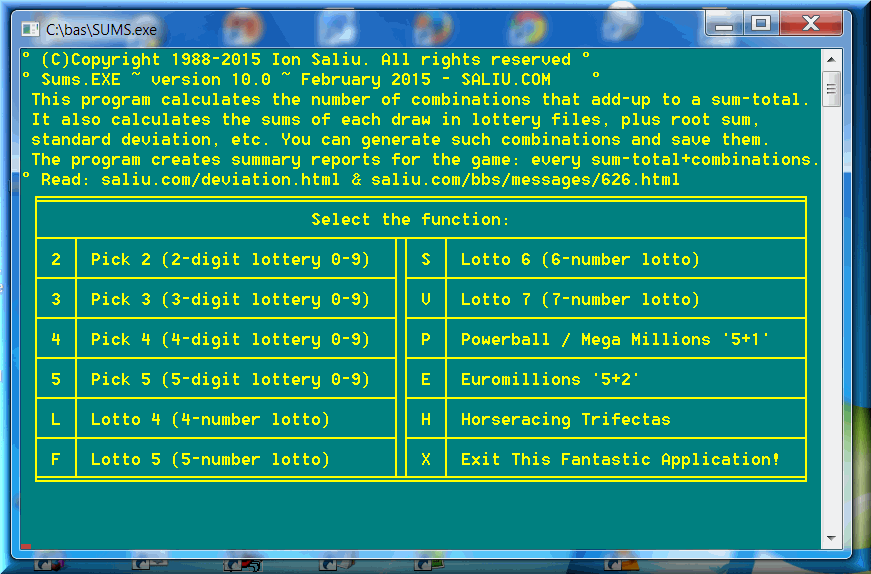
In any event, I made a child's wish come true! I wrote Sums, which can be downloaded from my software downloads site (see link below). The 32-bit application can generate all the combinations for any sum-total, in any lottery game: Pick-3, pick-4, Quinto (5-digit), lotto-5, lotto-6, lotto-7, Powerball, Mega Millions, Euromillions... and so much more.
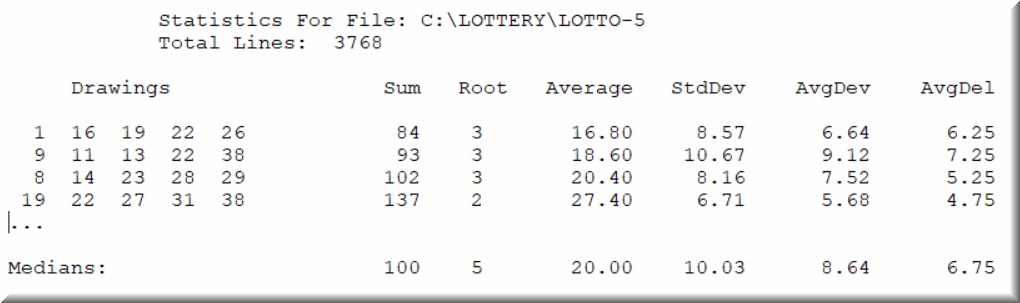
The application is extraordinarily powerful. It calculates meaningful statistics for a lotto/lottery data file: Sum, Root Sum (Fadic Addition), Average, Standard Deviation, Average Deviation from Mean Average, Average of Deltas. At the end of the report, Sums calculates the medians of the above statistical parameters. Function: S = Sum-up data files (in each of the 9 modules).
root-sums Here is a sample report for a statistically large data file in the Pennsylvania 5/39 lotto game.
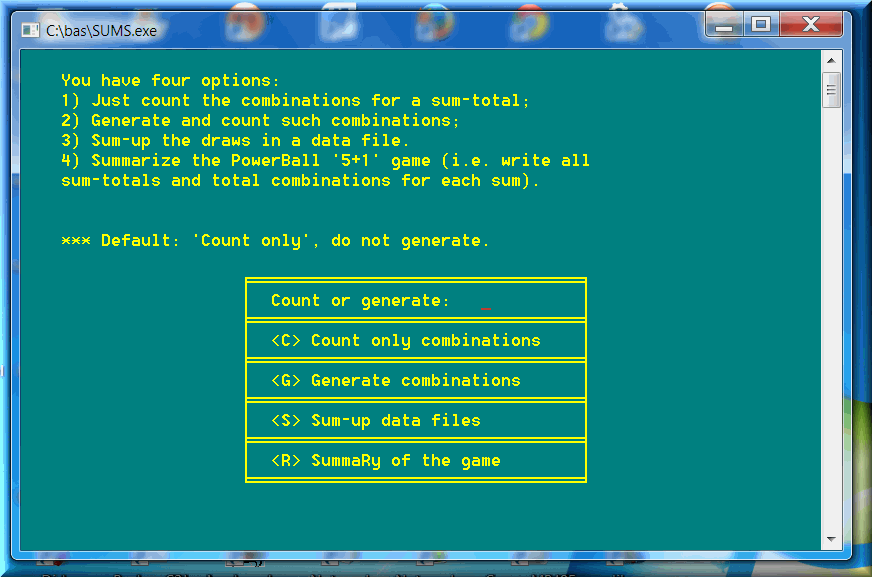
The combinations can also be saved to text files. Depending on a PC performance, a user can create text files for each sum-total in a lotto game in minutes (with the PCs of 2011). The program also plots a chart of all the sums in any lottery game. The sum-total chart looks like a Gauss (normal distribution) bell (or curve).
Apparently, there were problems with my 16-bit probability software Shuffle. Some informed me in the lines:
“This remind me of my problem now with your software (Shuffle) when loading, it return's this 'Error 9 at pgm-ctr : 1423' . However I have no way of knowing the Error Code, or perhaps my files are too large?”
Most likely, the file size was the problem. 16-bit DOS can only handle files up to 640 KB. I rewrote Shuffle as 32-bit probability software that runs at the command Prompt in all 32-bit and 64-bit versions of Windows. The program can also generate combinations for all kinds of lotto games, including Powerball, Mega Millions, Euromillions, with all their gazillions of combinations. The combinations tend to be like in real-life lottery drawings: the software generates unordered random numbers. I haven't met a file size limit yet. If you meet such a limit, buy more memory. Otherwise, keep in mind that 32-bit software has size limits, too. Exactly FOUR gigabytes (4 GB), mind you!
Yes, I feel already the restraints of 32-bit software (2011). The operating system I use, Windows 7 Ultimate, is 64-bit. Unfortunately, there is no true-64-bit compiler that I can use. For years now, I've appealed to the maker of the Basic compiler I use to upgrade it to 64-bit. I've received only promises!
”64-bit, Sixty-four,
Make us better than before;
32-bit, Thirty-two,
It was nice knowing you.”
Resources in Lottery, Software, Systems, Lotto Wheels, Strategies