
Lottery Strategy, Systems, Software Based on Lotto Number Frequency
By Ion Saliu, Founder of Lottery Software Mathematics

First capture by the WayBack Machine (web.archive.org) January 8, 2007.
FrequencyRank, version 4.1
- lottery and gambling software to generate frequency reports two ways:
- regardless of position;
- position by position.
SkipSystem, version 8.0
- lottery and gambling software to create lottery/gambling systems based on two or three consecutive skips;
- the program also generates the unique combinations from each system, including by positions.
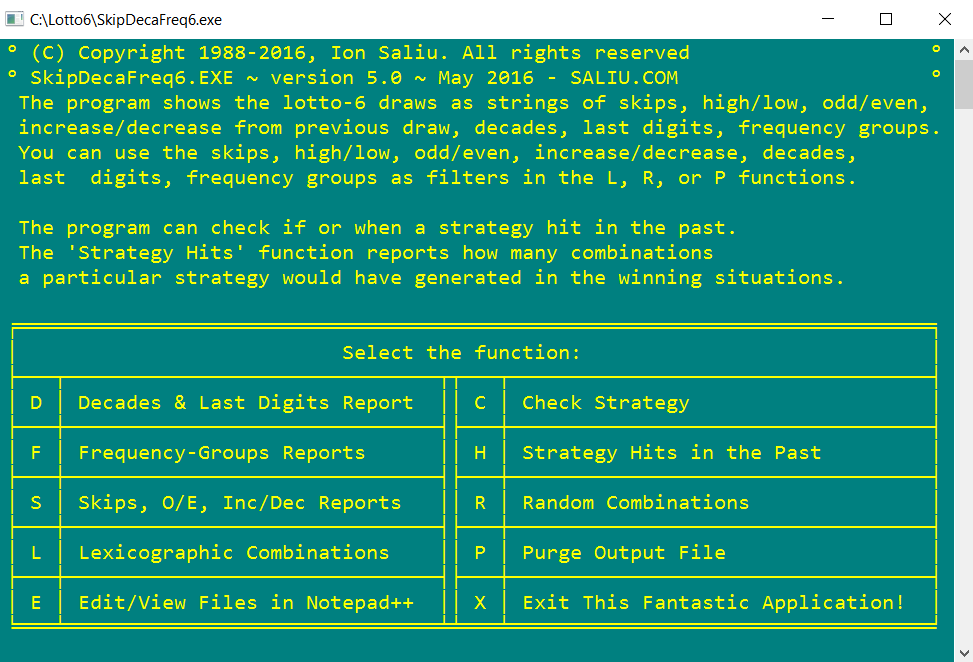
Greatly upgraded software for strategies, systems based on skips, decades, last digits, frequency groups ~ version 5.0, May 2016:
- SkipDecaFreq5 - software for 5-number lotto games;
- SkipDecaFreq6 - software for 6-number lottos;
- SkipDecaFreq3 - software for 3-digit (pick 3) lottery;
- SkipDecaFreq4 - software for 4-digit (pick 4) lotteries;
- SkipDecaFreqH3 - software for horse racing trifectas.
- Please be advised that some of these programs, released in 2015, require a special form of membership to download software: Ultimate Lottery Software. Click on the top banner to learn the terms, conditions, and availability. All my software is always announced in the Forums, New Writings, Software Downloads. The presentation pages are always published first. Such Web resources are free to read and help the reader make a decision regarding the licensing of software.
- The Decades, Last Digits program runs from the second menu of the respective Ultimate Software package, function S = Skips, Decades, Frequencies, Last Digits.
This new strategy is about lottery numbers divided into three categories based on frequency.
Let's create here a lotto strategy that is going to be pirated big-time! It happened to those eBay pick-3 lottery systems that were blunt examples of plagiarism of my theories. To their credit, eBay fixed the problem after I filed a copyright infringement complaint. Read how users of my software came across the piracy acts while bidding on eBay:
I take as an example a lotto 6/49 game. We divide the lotto numbers in three frequency categories as follows:
1) Group 1, the most frequent: 1/8 (12.5%) of all numbers = 6 lotto numbers;
2) Group 2: 37.5% of all numbers = 18 lotto numbers;
3) Group 3, the least frequent: 50% of all numbers = 25 lotto numbers.
The division has a good foundation: Fewer numbers with higher frequency lead to better playing efficiency. Here is an example that shows favoritism towards the groups with the most frequent numbers. The game is pick-4 played in Pennsylvania Lottery.
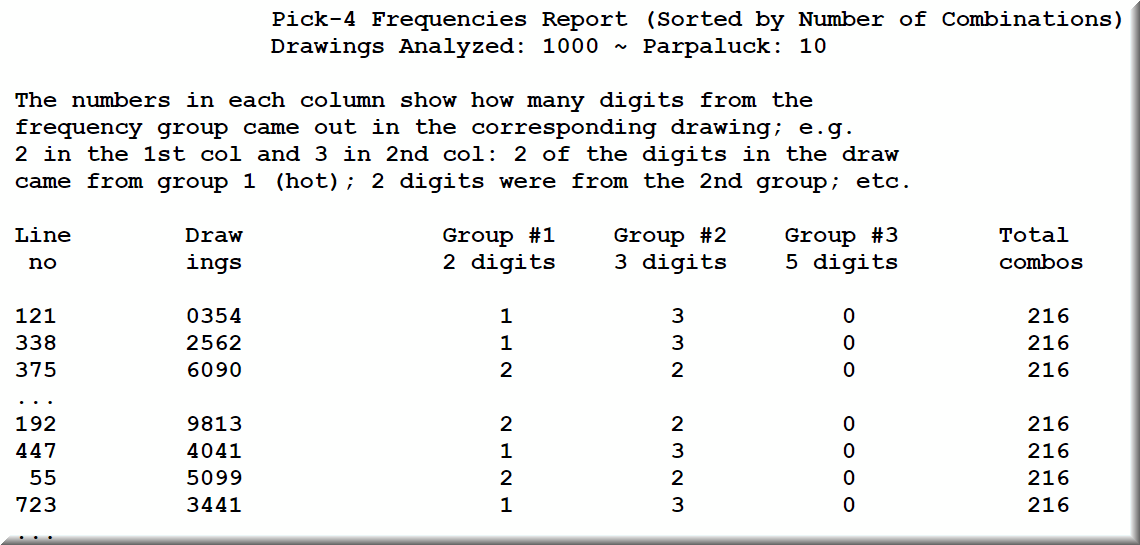
We have two distinct frequency groups (1-3-0 and 2-2-0), both generating the same amount of pick-4 straight sets: 216. But the group with more digits in the most frequent group (2-2-0) registered 24 hits. The group with only one digit in the primary frequency group (1-3-0) recorded only 16 hits. The 2-2-0 configuration shows a 50% advantage.
- That is a wicked lottery strategy that mocked me several times. Last time, it happened in less than 2 months — April – May 2016 — or about 10,000 dollars. Latest it happened, May 27, 2016, it was due to an unexpected stormy afternoon that lasted the lottery drawing. The 216 raw pick-4 straight sets were reduced to under 10 by the safest of LIE elimination settings. The strategy had a skip median equal to 27 prior to the latest hit (currently 28). The plan was to play the strategy up until 40 drawings (to cover 2/3 of total hits).
- It was not the end of it! If players in Pennsylvania Lottery paid attention — and played the strategy! — they made $5000 in a couple of days. This pick-4 strategy had 3 $5000 hits in 42 days in the April – June 2016 period.
- The end was still far away, diligently axiomatic Pennsylvanian fellow of mine! From June to September of the year of grace 2016, the exact same strategy hit 8 more times:
- 16 | 15 1 29 12 4 7 30 10 | 28
- The hits are between the two | bars. 28 represents the last hit (see the Skips below). The first number in the string (16) is not completed (still running).
- Amount of drawings played: 108 + 8 = 116. At a maximum price of $20 per play, total cost amounted to $2,320.
- Total winnings: $5,000 * 8 = $40,000. ROI (return on investment): 1724%. This must be the most efficient lottery strategy in history!
- All that time, I wrote more software, I was very busy fixing SEO issues with my website, busy and angry solving the hacking and spoofing of my phone... (Not to mention the Sword of Damocles hanging above my head forever it seems like... threats of withholdings due to abusive application of law...)
A few graphics (easily replicated by data in Pennsylvania Lottery)

* The pivot of the strategy:
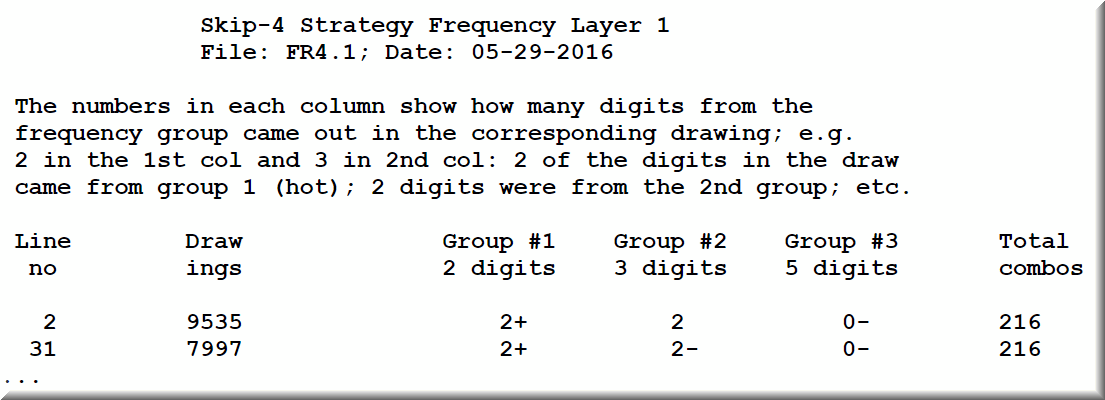
* LIE elimination rule obeyed: The settings from the very previous draw were not repeated. Just a few examples:
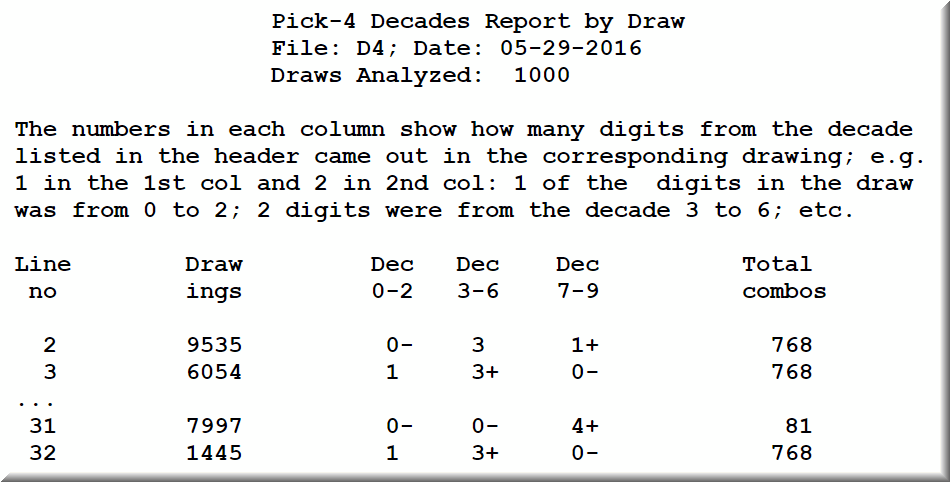
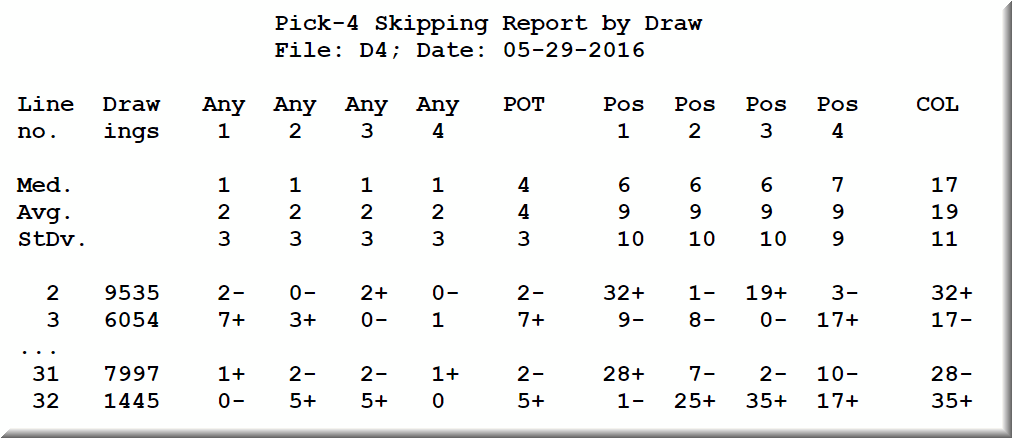
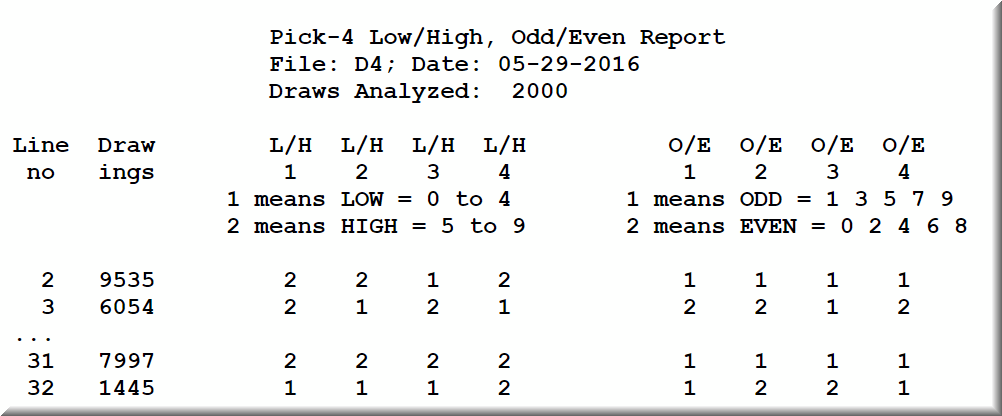
Data with reports from other LotWon applications is even more strongly misaligned —
the bread-and-butter of LIE elimination lottery strategies.

- The best way to apply this super lottery strategy: Instead of playing the strategy one at a time (layer by layer), play the strategies for all 6 layers at the same time. I named the 6 strategies as STR-FR4-1-220 to STR-FR4-6-220. I added the OUT extension to the strategy filename for the respective output file. This combined lottery strategy hits around 1 in 6 drawings.
- Combine/concatenate the 6 output files in one (e.g. BIG.FR4). Do NOT purge the duplicates, as the strategies hit simultaneously sometimes (about 15 times). We slightly increase the cost, but we increase the winnings by thousands of dollars.
- The combined lottery strategy hits around 170 times in 1000 real lottery draws, with 12-15 hits being common to 2 or more strategies.
- Generate... generously LIE files to further reduce the amount of tickets to play. Some things are almost automatic LIE Elimination candidates. The top half of lotto numbers / lottery digits do not hit the very next drawing. The bottom half based on frequency fares even worse. The same about the skip systems: The FFG-SYS skips system files do NOT hit the very next lottery drawing; the FFG-SYS skips systems based on over median fare even worse in the very next draw.
- If you look at the WS files, you notice that no groups of 5 filters hit exactly in the next drawing. The combinations generated by those filters ought to be added to the final LIE file. All filter reports should be analyzed to find groups of filters that will not hit, combined, in the very next lottery drawing. How LIE methodology beats the odds badly: LIE Elimination, Reversed Lottery Strategy for Lotto Decades, Last Digits, Odd Even, Low High, Skips.
- As I have always stated, especially on this website, there is NO absolute certainty in the entire Universe. That's an undeniable mathematical law (FFG). Therefore, we can experience a wrong LIE Elimination result sometimes. Personally, I haven't been wrong more than 1% of the time. The degree of certainty DC that a losing LIE situation hits at the same time with a hit of the combined lottery strategy is around 1/6 * 1/100 = 1/600. It is adequately safe in my book.
- The above information in this indented paragraph was based on data created on April 4, 2017. The aggregated pick-4 lottery strategy missed 6 drawings, then hit 2 times in the next 4 draws. I saved the output file of that day (BIG.FR4, always with 1296 straight sets in this strategy).
- I waited 10 days and then checked for winners. The top 10 drawings in the data file acted as "future" drawings.
- The BIG.FR4 output file recorded 3 straight winners (I disregard the boxed wins as they have a worse house edge).
- The aggregate strategy created 10 days earlier made a profit. Granted, it is out of question paying 1296 monetary units a day. It is necessary to always apply other filters, and especially the LIE Elimination tactic. Even if wins are eliminated in the process, the much lower cost increases the profit.
- All lotto strategies are based on filters. A good lottery strategy based on number/digit frequency starts with the group 2-2-0 as the pivot. Apply other filters (that show safe values for the next draw) at runtime. In other words, we purge the 216 combinations by the specific function in all Parpaluck's lottery software applications.
The 6 winning numbers in a lotto draw will have a distribution such as: 2-2-2: 2 numbers from the top 6, 2 numbers from the middle frequency zone, 2 numbers from the least frequent group.
I created a table for a few examples of distribution. How many numbers in each of the three frequency groups; number of winners in each group; then, in the brackets, how many CombosNations from that group; lastly, how many total lotto combinations by the distribution?
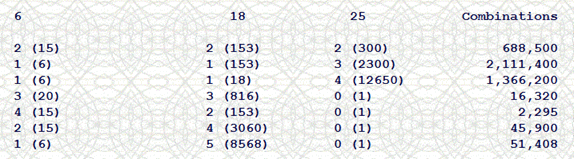
- You start with the least frequent lottery group: 50%. Round up to the next largest integer: 20. Then, select the most frequent group: 1/8; round off to the next lowest integer. The rest of the numbers go to group 2.
- Use the combination formula to calculate the number of combinations in each group.
- group 1: C(5, n1), where n1 is number of winners from the group. Eg C(5, 1) = 5; C(5, 2) = 10; C(5, 0) = 1.
- group 2: C(14, n2), where n2 is number of winners from the group. Eg C(14, 1) = 14; C(14, 2) = 91; C(14, 0) = 1.
- group 3: C(20, n3), where n3 is number of winners from the group. Eg C(20, 1) = 20; C(20, 2) = 190; C(20, 0) = 1.
- Total combinations is the product of number of combinations in each group. For example, the case 1-2-2 gives 5 * 91 * 190 = 86,450 total combinations. The 0-0-5 case generates C(20, 5) = 15,504 lotto combos.
- You can choose randomly from all those combinations, or purge the output file.
Another point is the parpaluck (range of analysis or how many lottery draws to analyze). You chose N * 2 (78 past draws). The degree of certainty for N = 78 is DC = 99.99%. That means that 99.99% of the lotto 5/39 numbers will come out in 78 drawings. I would try lower parpalucks, like N (39 drawings) or N/2 (20). The parpaluck is higher for pairs, because the probability is lower.
Calculating the number of combinations should be the easiest part. I said previously "to apply the combination formula". It is hard to apply a formula manually. There are hand-held calculators with a function that calculates the combinations C(N, M); e.g. C(49, 6). My calculator (Sharp EL-531D) has a button labelled nCr. You type 49, then press nCr, then 6, and finally nCr.
My lottery software also calculates the number of combinations with ease. The easiest one is OddsCalc. It can be downloaded from my downloads site, software category 5.6 Scientific software: Mathematics, statistics, probability, combinatorics, odds, algorithms. Odds Calc calculates all the odds in the game; e.g. from 0 of 5 to 5 of 5. The 5 of 5 is the only one needed in the case of this strategy.
Also, MDIEditor Lotto WE calculates the number of combinations as C(39, 5). Steps in menu: Lotto, Lotto Odds. Type, for example 18, then 5; or 20, 3. The program will display total number of combinations for those two parameters. It will also generate lottery combinations for that format. Just type 1 for number of combinations to generate.
By the way, I think the best distribution for pick3 or pick-4 should be:
2-3-5
The best distribution for single-zero roulette should be:
4-14-19
The best distribution for double-zero roulette should be:
4-15-19
I calculated total combinations for various frequency cases. I compiled the calculations in tables: Frequency groups pick-3, pick-4 lotteries, lotto 5/39, 649 lotto.
You can see real-life reports for Pennsylvania Lottery Cash 5 game (lotto 5 of 39). The reports show the influence of the parpaluck in the appearance of the lotto numbers based on frequency. Read: Statistical Frequency Reports for Pennsylvania 5/39 Lotto.
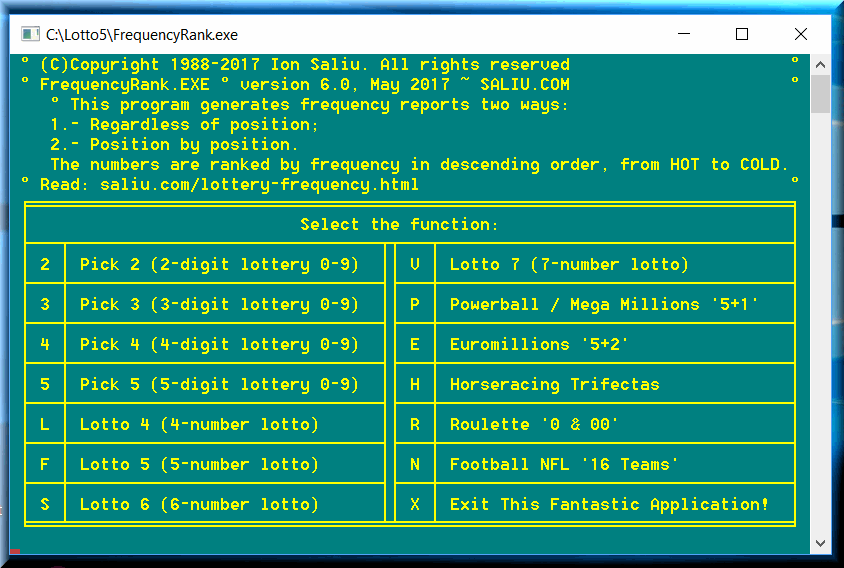
FrequencyRank has a special feature. The program lists the lottery numbers by frequency: From the most frequent number (hot) to the least drawn (cold). This is the very traditional method of utilizing lotto strategies. The numbers are divided in two or three categories: Hot, mild, cold. Most lottery "experts" strongly recommend to play mainly hot numbers; or mostly hot numbers with a few milders mixed in.
The traditional lottery strategy based on number frequency is not nearly as potent as our new strategy created above.
Still, my lottery software Frequency Rank has a pretty good following. Not to mention that its workings are used illegitimately by several Webmasters. I also offer paid-for Web pages with statistical reports created by FrequencyRank for Powerball, Mega Millions, and Euromillions.
In truth, Frequency Rank offers the best options to create text files to represent lottery systems based on the traditional frequency. The user can copy and paste strings of numbers generated by the program and pasted in a text editor (Notepad will do). The lottery frequency systems can be: regardless of position and position by position.
Non-positional frequency systems consist of 1 line (regular lotto), or 2 lines (Powerball, Mega Millions, Euromillions):
4 48 13 39 42 28 33 19 10 16 35 2 49 43 46 7 37 41 5 36 32 21 24 26 27 18 31 17 25 8 6 20 29 11 38 9 15 44 40 1 3 12 14 45 22 34 23 30 47 (6/49 lotto)
In this case, the 6 most frequent (hottest) lottery numbers, regardless of position, were: 4 48 13 39 42 28. The 6 coldest numbers were: 47 30 23 34 22 45.
Positional frequency systems consist of multiple lines, one for each number position in the game (e.g. 6 in 6-number lottos or Powerball; 7 in 7-number lotto or Euromillions).
All you have to do, l'axiomatique, is copy as many lotto numbers as you want (10, 12, 18, etc.) and paste them to Notepad. Save to a text file with a mnemonic filename. Be sure not to leave any empty lines in the file!
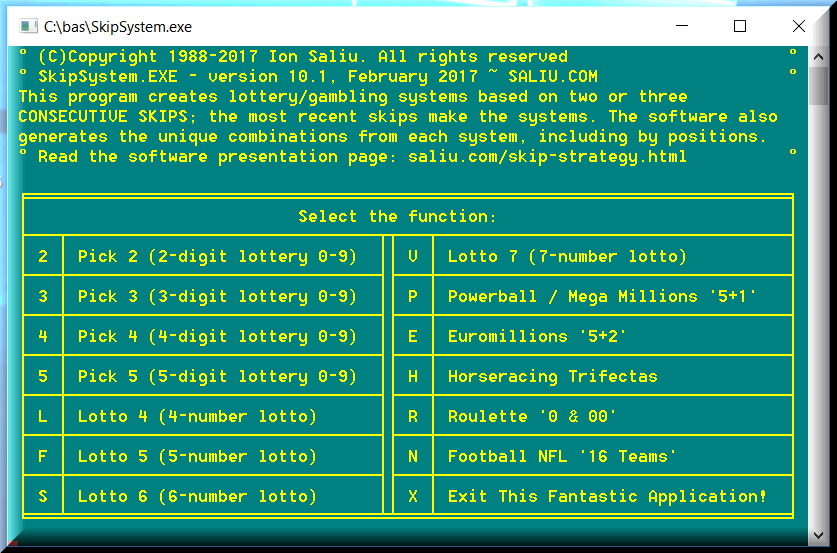
So, you have ready a system file based on lottery frequencies. The next step is to generate lotto combinations from all those numbers you saved to disk. There is no better software than the very program you see above: Skip System. First of all, the comprehensive program creates even better systems than those based on traditional frequency methods. But that's not all. Skip System has special functions that generate the most precise lotto and lottery combinations, including from positional systems (multi-line files). Read: Skip Systems, Software for Lotto, Lottery, Powerball, Mega Millions, Euromillions.
Resources in Lottery Software, Strategies, Lotto Systems
- The Main Lotto, Lottery, Software, Strategy Page.
Presenting software to create free winning lotto, lottery strategies, systems based on mathematics. Get your lotto systems or wheels, the best lottery, lotto software, combinations, winning numbers.
- Lotto, Lottery Software, Excel Spreadsheets: Programming, Strategies.
Read a genuine analysis of Excel spreadsheets applied to lottery and lotto developing of software, systems, and strategies. Combining Excel analysis with powerful lottery and lotto software programmed by this author, Parpaluck.
- MDIEditor Lotto WE: Tutorial, Software User Guide, Manual, Book, ebook.
~ Also applicable to my entire lottery software; plus Powerball, Mega Millions, Euromillions.
- Visual Tutorial, Book, Manual: Lottery Software, Lotto Apps, Programs.
- Lottery Mathematics, Lotto Mathematics,
Probabilities, Appearance, Repeat, Number Affiliation, Wheels, Systems, Strategies.
- Lotto Decades, Last Digits, Systems, Strategies, Software.
- Practical Lottery and Lotto Filtering in Software.
- Skip Systems, Strategy Lotto, Lottery Skips, Powerball, Mega Millions, Euromillions.
- Lotto, Lottery Strategy in Reverse: Not-to-Win Leads to Not-to-Lose or WIN.
- LIE Elimination: Lottery, Lotto Strategy in Reverse for Pairs, Number Frequency.
- LIE Elimination, Reversed Lottery Strategy for Lotto Decades, Last Digits, Odd Even, Low High, Skips.
- Lotto, Lottery Strategy: Root Sums, Skips, Odd Even, Low High, Deltas.
- Lottery Utility Software: Pick-3, 4 Lottery, Lotto-5, 6, Powerball, Mega Millions, Euromillions.
- Software to Generate Lotto Combinations with Favorite Lottery Numbers in Fixed Positions.
- Theory, Analysis of Deltas in Lotto, Lottery Software, Strategy, Systems.
- Markov Chains, Followers, Pairs, Lottery, Lotto, Software.
- Lotto Software for Groups of Numbers: Odd, Even, Low, High, Sums, Frequencies, User's Groups.
- The Best Strategy for Lottery, Gambling, Sports Betting, Horse Racing, Blackjack, Roulette.
- "The Start Is the Hardest Part" in Lottery Strategies.
- Strategy Lotto Software on Positional Frequency.
- Download Lottery Software, Lotto Programs.
Of interest:
Home | Search | New Writings | Odds, Generator | Contents | Forums | Sitemap